Tuesday, February 5, 2013

Realtors: Poor imagery is not doing you or your client any favors

Realtors: "Poor imagery is not doing you or your client any favors" OR "make sure your photographer gives you what you are paying for"


I thought that I would combine the two topics above seen as I was going to take a couple of shots to illustrate my point. 

I believe that quality photographs have a critical role to play in the marketing of real estate, just how important that role is differs according to whom you speak, I know successful agents who swear that the quality of photographs are not important but then again I know some successful agents who do not spare any expense and they seem to do pretty well for themselves as well.
The characteristics of what constitutes a quality photograph is open to interpretation, I believe that photographs need to be clear, well lit representations of the property that help convey the strengths of the property and fit into the agent/brokers/owners marketing campaign. They do not need to be taken by proffessional photographers.

Whether you believe that quality of photographs play a role in highlighting a property or not there is no disputing that the internet increasingly plays a role in many buyers pre-selection strategies.  As a buyer it is difficult to seriously consider a property that has been marketed online if it has no attached imagery, there are just too many choices with images to waste your time, and when faced with a number of choices and a buyer's market I believe that the properties not displayed adequately are also disadvantaged.
Imagery figures prominently in agents/brokers/owners marketing campaigns, the money shot is the first shot a potential buyer sees, it either commands attention or doesn't.   On Realtor.ca and the print media booklets such as HOMEGUIDE and "The Real Estate Book" the money shot is usually a picture of the front facade.  Realtor.ca and the booklets websites "RealEstateBook.com" and "nshomeguide.ca" act as a great equaliser when it comes to photographs as they reduce and compress the photograph to such a degree that they can make any house look bad.   The quality of imagery on agents and brokers sites are improving all the time in terms of the visual experience they offer, while alternative sites to Realtor.ca which offer a lot more value to buyers such as "viewpoint.ca" are making a strong bid to become the site of choice in Nova Scotia.

That is not really why I wrote this opinion piece it is really for those agents who are using a photographer and still fall into the poor image category, you need to get fair value for what you pay.  
The most important piece of advice that I can offer is talk to your photographer about what you want, yes they may be the proffessional but like music everybody knows what they like and not everyone is a musician, it is important that your view is articulated before shots are taken.  I make a point of asking my agents whether they have preferences, I have an agent who loves crown moulding and insists that a couple of shots are taken that highlight this aspect; as an individual I am immune to the charms of crown moulding  and probably wouldn't give it special attention if left to my own devices.  Many agents will just give you the go ahead and then probably simmer a little when the results don't match their non-articulated expectations. 

If you are paying someone the outputs that a photographer sends you should be in focus, crisp (have clean lines), colours need to be realistic, lines should be straight and the photographer should have some knowledge of how to present  the room/feature being shown.  Typically a photographer will use a super wide lens when taking real estate shots.  These lenses tend to give you slanting verticals (look at the windows and doors), if the images you receive have features that look like the leaning tower of Piza  then your photographer is being a little lazy, part of the price you are paying is for post processing to ensure that these aspects are taken care of. 
If your photographs are to be used in Realtor.ca the money shot should be prepared to be displayed at an inordinately small size, the thumb size is 150x110 pixels on the site while the other photographs dimensions are slightly bigger (a height of 200 pixels and width of 240 to 320 pixels seem to be the norm) they are still pretty small.  If looking for better quality the photographer should tailor images to fit those dimensions rather than leave it to the site to resize and compress the pictures.  In practical terms your photographer should supply the images in at least two sizes depending on their use.

I took a few shots of our kitchen to provide a couple of examples of what's acceptable and what's not (in my opinion).  Each of the shots is as it comes out of the camera with the exception of the HDR's which were processed.
 
A pretty terrible picture of our kitchen, it was taken with an i-phone - the picture is soft, the light is all natural, the inside is dark the window too light, the dish towels and drying pots are distracting the list goes on - there are a surprising number of photographs of this quality advertising properties on the internet today.
I turned the houses lights on for this shot, you can see a few details out of the window, the picture is less soft but far from ideal , this too was taken with an i-phone.


The same setup as above, but taken with my Canon SLR, I removed the towel on the left and the pots, this shot has the same lighting as above but this is a HDR - (two or more shots that are tone mapped to produce a single shot), the colour is natural.  Although the image is well lit it looks darker when reduced, one of the reasons to reduce it using software and treat accordingly.
HDR with the colours overcooked some people like it saturated, overcook it a bit more and the fixtures start to look like they were moulded in plastic. 


A single shot with a flash, the image is overcooked behind the hanging light where it loses definition (and there is a slight blue caste to the photo).


The same flash shot with a slightly warmer white balance.


Image taken with studio lights the colour balance is good, it is clear, the image is in focus the verticals are pretty straight. 
 
 
I would be happy to tweak any of the photographs from the HDR on with the exception of the overcooked HDR.
If you look at the pictures on the left both are 200 pixels high (Realtor.ca size) there is a huge difference between the i-phone picture we started with and what we ended with even though  the effect is partly mitigated by the pictures dimensions. 

Neither photographs are great shots compositionally but in my mind there is no comparison, if I was a buyer and faced with choices in a certain price range and area I know which kitchen would catch my eye. If I was the seller I would seriously consider whether my agent had my best interests at heart if they used this particular i-phone picture or something equally grotty (please note I have nothing against i-phones I am sure in the right hands they are capable of producing amazing photos).

I believe that "quality photographs" have a critical role to play in the marketing of real estate, I don't think that you have to have a professional to take photographs of your properties by any means but I do think that if you are advertising in certain media you should take advantage of what that media has to offer.  The internet has become the channel of choice for buyers to view properties, visual imagery attracts attention to a property creating internet "foot-traffic",  as sites marketing real estate embrace the opportunities offered by the channel, poor imagery will increasingly be exposed as bad advertising props, I do not see this trend regressing in the near future .  


Sunday, September 9, 2012

Photographing a location multiple times

Peggy's Cove and Peggy's Point Lighthouse - photographing a location multiple times

Someone asked me the other day why I, as a photographer, kept on going back to Peggy's Cove.  The question is valid - Peggy's Cove has been photographed millions of times, if you Google images with that name there are over 1000030 hits, there are some well known photographers with images that are included in that result.  I don't know how many times I have been out there, I don't keep score but it is a lot.  The truth is I like going out there, it is an easy ride, close to the city.  From a photographic point of view you always see something new, the weather differs, the seasons change the props change. 


There are a number of places that photographers seem to need or want to photograph, Upper Antelope Canyon comes to mind ,I have seen thousands of photographs of the canyon a lot of them are really good, most look the same, I would still like to photograph that location, I like the anticipation and preparation, I want to know what it feels like, the heat, the light, the challenges and when I am finished I have the memory. I can appreciate a well crafted photograph without visiting a location but only after I have taken a photograph at a location can I truely appreciate the photographers eye for detail.


So why go out to Peggy's, I don't have a definitive answer but when I got to Peggy's at  5am this morning I was the sole person there until 7.30am, I sipped coffee while sitting on the rocks watching the choppy surf, it's a privilege that I appreciate and when I don't see the beauty anymore I will stop going, until then I hope to go many more times.

Friday, July 20, 2012

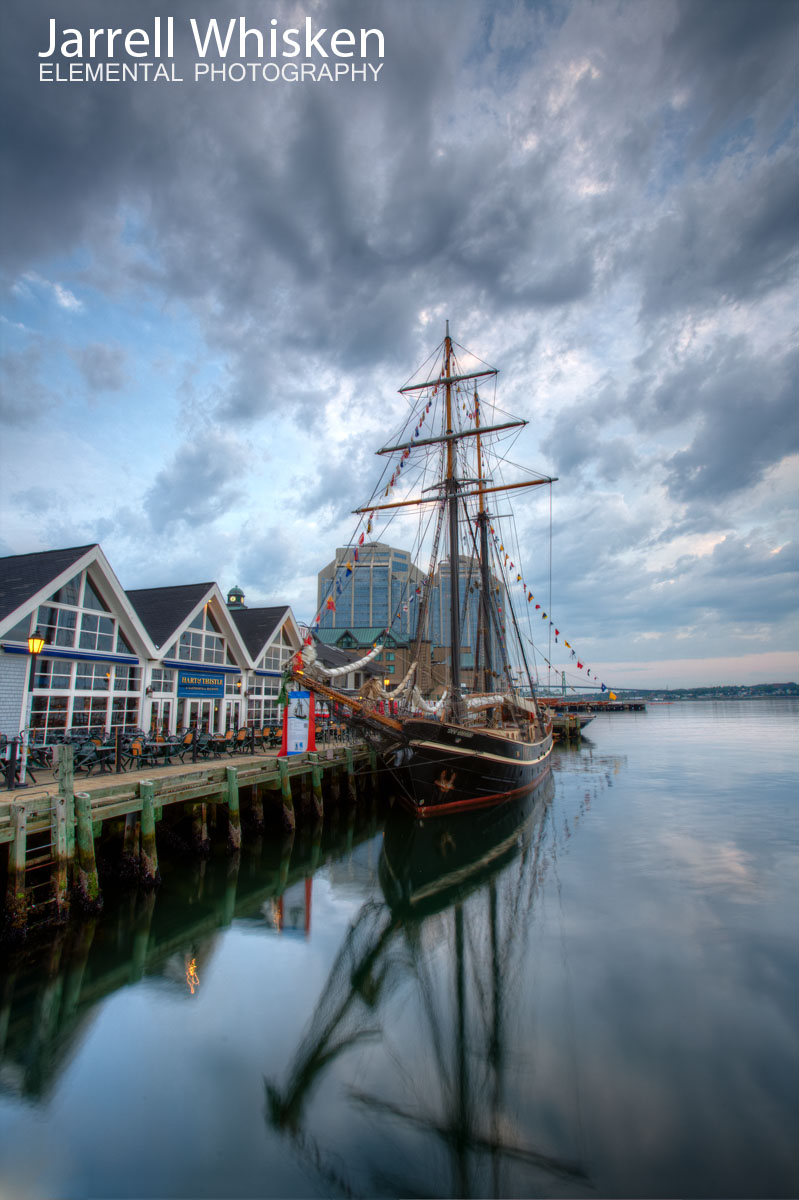
Halifax, Tall Ships 2012

I have visited a lot of harbours around the world most can only be categorized as highly undesirable areas that you can't wait to get through without being mugged.  Halifax Waterfront is one of the cleanest and most accessible berthing areas that I have ever visited it is also one of the main venues for the Tall Ship Festival.

The waterfront already has a couple of Tall Ships year round in the MAR and Silva, the first ship "from away" arrived on Tuesday and since then they have trickled in culminating with the arrival of the USCG Eagle at 10.30 this morning.   I have visited the  waterfront a couple of times over the past two days, the latest this morning with my buddy Darrell.
It is always nice to visit the waterfront at 5am I have always felt safe there thanks in part to a small unobtrusive security presence.  The waterfront area now boasts a number  of "tents" to host the crowds and other activities.  Security has also been stepped up which I can understand given the international flavour of the event.  There are roving patrols and a guard stationed at each of the access points to the floating docks at 5am the security compliment far outnumbered the couple of photographers willing to get to the site before sunrise (although they have apparently just finished controlling the night time revellers so essentially we are the second shift).  As a photographer I haven't encountered any problems with overzealous security and Canadian Security personnel are courteous  but I am not too fond of the ugly security barriers that surround access to the floating docks as they are no more effective than the rope barrier normally used.  I do understand their use when the ship gangway connects directly to the wharf.  In addition Sackville wharf was blocked off for some reason?  Again I am not too sure why  the only Tall Ship moored there was the Lynx on the one side and the HMSC Sackville on the other others have since arrived.  By 6am the barrier was removed so it seems arbitrary and more than a little disappointing that there is no access to that area during the best light of the day.   Having said that the Wharf area to HMS Bounty was also blocked off after the ship arrived, there is also talk that security would be stepped up over the weekend which might entail making even more areas inaccessible outside the ship visiting times (the Canadian equivalent of DEFCON 1, I jest it is currently at MARSEC Level 1 which is the security level for which minimum security procedures are maintained at all times by vessels, ports and marine facilities, as defined by the Marine Transportation Security Regulations (MTSRs) whatever that means) which I hope doesn't happen.
Anyway enough whinging, I have heard that the event is small compared to 2000, but it doesn't matter, the tall ships are works of art and should be seen, they hint at bygone eras where men where men (i.e. they had little idea where they were in relation to anything else, these ranks have been joined by a crew made up of just woman, they are probably in the same boat - so to speak).

There have been some nice folks at the docks taking photographs one of the first people I met was Peter Spence who has a Nikon Podcast - http://blog2.nikonians.org/northernexposure/ . I also met a photographer from Sri Lanka who was far more interested in talking than taking photographs and a couple from Moncton who had travelled through to have a look. There are a lot of big lenses around and a lot of photogs.
The big ships themselves are a mixed bag, I only shoot in the early morning which is a bit limiting in terms of light, however I don't like big crowds and I prefer not to have hoards of people in my shots, but that is just me. As a consequence certain tall ships are better positioned than others to be photographed. I cannot say that I am happy with the results but it has been fantastic walking the docks in the early morning, soaking in the tall ships atmosphere.
The Roseway

STV Unicorn

CSS Acadia

The Gazela

The Larinda (my favourite small tall ship with a history)


A modern traveller in the midst of the tall ships the Nashira II has the tallest mast of all the yachts in harbour although she may have competition from the Eagle.

There are still a couple of days left and then the Parade of Sails on Monday before the ships head out to Lunnenburg and various other destinations I am hoping to get in a couple more shoots during this time period.


Monday, May 7, 2012


Event photography: The art of being invisible.....or not.

I am far too polite to rant but I do have a pet peeve every now and again.  My peeve is fostered in the art and science of invisibility or in many cases the lack of it.  I have attended a couple of functions lately where the event photographer was the center of attention.  I am not sure if anyone else has come across this breed of photographer, I have been told that they are not rare, personally I think they should be extinct, but I am hard core and don't expect everyone to share this view.  Although they fall under the same category there are distinct subspecies, I have called them "the flasher" and  "center stager" (my spell checker tells me this is not a real word it is therefore a Whiskenism).

I met the Flasher at a charity event, he looked professional, blended in with the crowd and didn't have "Professional Photographer"  festooned in large letters on any part of his clothing.  Anyone who looks presentable and fits in with the theme of the event gets an approval tick from me (please note that an approval tick from me counts nothing in the greater scheme of things, in other words it has equal weight with my pet peeves).  He was on time another thing that smacks of professionalism.  He had a shiny new SLR complete with an awesome shoe flash.  The awesome flash had a fantastic recycling rate which he used to good effect taking hundreds of photographs from the same spot somewhere behind my right shoulder.    During the event three speakers stood motionless for varying amounts of time at a podium, in addition a couple of awards were presented to deserving recipients, all got ample recognition from our intrepid flasher.  Our flasher obviously adopted the strategy "better to be safe than sorry", although the scene was pretty static one can never have too many photographs of the same thing, it is after all one of the things we love about digital photography.  

My peeve is related to the small lightning flashes, the distinctive click of the camera and the whine of the charge every few seconds, personally I find it annoying, disruptive and totally unnecessary, the fact that no-one had an epileptic episode was not through lack of trying.  The room was well lit and I had a feeling that if you put a fast lens on the super duper camera a flash would not be necessary at all, I have shot functions in terrible lighting where a good fast lens can makes the difference, obviously being in control of the situation and generating your own light is sometimes necessary.

Filled with evil thoughts I balanced them with possible excuses for our flasher (I am critical but fair), NGO's are not known for big budgets an extenuating circumstance when booking photographic talent (free usually sounds like the right price).  In addition photographers starting out cannot always afford suitable lenses, (although an investment in a 50 prime one of the fastest cheapest lenses on the market and not too bad a focal length on a camera with a 1.6 crop factor should be in most photographers budgets).   I kept this in mind as I talked to the photographer after the event, he was pleasant, well spoken and entirely likeable another plus when roaming events with a camera.   I was obviously impressed with the battery capacity of his flash which had done a manful job of keeping up with his itchy trigger finger, I commented on its great recycling rate, he told me it was fantastic especially when he did weddings.   The flasher is not someone I would employ to do my wedding but I have seen the results of his labors.

My "Center Stage" photographer was brash and confident, everything a photographer should be at a corporate event, she was also a flasher although her flash was not as good as "The Flasher" and she was slightly less prodigious as a result.  She was also appropriately dressed, score 1 point, she moved around the venue and got different angles and people score another point, she also stood for an inordinately long time in front of the speaker, blocking our view on multiple occasions while she reeled of shot after shot, I don't give points for this.  Again our speaker was not moving, he was not doing an act and he spoke for thirty minutes, more than enough time to take a well considered shot, duck down or disappear from center stage, review the shot and repeat if necessary.  I admired the Centre Stager she had panache she had flair she looked the part (you know the one where the stereotypical  fashion photographer adopts fantastic poses to get the right angle and you immediately resolve  to see if your body can bend like that, later, at night, in a dark room.....alone...in front of the mirror).  

Both the Flasher and the Center Stager have contrived maybe unwittingly to make the event about them, I am all for getting the shot but take it and move on, some actions happen once, you need to be sure of your equipment and talent to get the shot, use your flash if necessary and move on.  There are poignant moments when people deliver speeches make sure you know what and when they are and that you are in a place to get them, then move on, it allows people to concentrate on the reason they came to the event  which 9 times out of ten was not to watch you in action (Please note that in this case the "Center Stager" was at least if not more interesting than the speaker and may have had a more favorable ratio; this rule does not apply in any parliamentary debate where the photographer is definitely the most interesting person on show).

Most event coordinators prefer a conservative approach, they want evidence that the event took place they want those special moments captured in an artistically pleasing way that suits the style of the event but they want you to do it as unobtrusively as possible.  This does not apply if you are really famous and the coordinator paid an obscene amount of money for your talent, then you are quite possibly part of the show and may need to perform. (Jarrell Whisken is the Managing Director of Thomas International Maritimes, he is an avid landscape photographer with a love for open spaces, he dislikes people in his photographs and goes to great lengths to ensure they are not there, he also attends a lot of functions.....he also thinks he is reasonably funny - multitudes have pointed out that this is not the case yet still he persists).

Saturday, May 14, 2011

Photographing the HRANS Conference

I was the official photographer at the Human Resources of Nova Scotia Conference (HRANS) in Halifax from the 4-6 May, the first conference I have ever covered.   What I found was that Landscape photography had not exactly equipped me for this type of event and there was a steep learning curve.

The main challenge encountered during the conference was low light conditions (no natural lighting at all and a mixture of fluorescent and Halogen lights).  In addition there was a leaning towards no flash photography as this would disrupt the flow of the speaker and my job was to be unobtrusive. Technically this is a challenging environment.  On the plus side I have good lenses, a Canon 24-70mm F2.8, 16-35mm F2.8 and a prime 50mm F1.4.  

I played around a bit with settings and found it is best use time or aperture settings to limit the number of variables (automatic was just too slow and led to blurring).   The easiest way I found to avoid blurring was to underexpose slightly and spot meter on people’s faces which gave reasonable results, especially for keynote speakers.  I also needed to pump the ISO up to at least 1600 which on my camera  means noise.
Don Bell - one of WestJet's founders

A group photo of 50+ people at night proved to be the most challenging shot of the conference (mainly because all the CHRP recipients would want a photograph),  I did scout for a suitable location during the day but the choices were limited and I ended up doing a lot of photoshop, in the future I think lights and backdrop are  must for more control of the environment.
  
CHRP Recipients

The conference organizers wanted to show the vitality of the conference, people listening and enjoying themselves, not my normal style to interact with my subject but by the end of the conference I found I was enjoying the people interactions, all in all a great experience, one I hope todo again.

Trade show delegate

Sunday, April 17, 2011

Trip to the Eastern Shore - 16 and 17 April 2011


Needed to get out of the “big city” this weekend.  We toured Nova Scotia in 2008 but we missed the East Coast due to a hurricane.  We decided to remedy this with a trip to Sherbrook Village and possibly Canso.  I  decided to take a couple of photographs at Lawrencetown beach before heading down the coast.

Started rather late Saturday morning I like being at a site before sun-up but when traveling with others you need to make allowances.  Lawrencetown beach is well known to local surfers, it has a nice shore break, complimented by a stunning rock beach.  Saturday morning was cold minus 6 when we headed out, not a typical spring day, there was some good cloud colour which helps saturate the colour of the rocks.  First time at this spot but I will definitely be back in the near future.

Lawrencetown Beach
Ended up in Sherbrook at midday.  We were the only residents at the Motel which suited us fine.  We explored the area including the “old village” which includes period piece actors/villagers in the summer season.   

Sawmill - Sherbrook Village
 We eventually wandered down a little lane leading to Walters Cove an area which really typifies the glaciated heritage of the area.  I decided to visit again the next morning, I am pretty happy with the results it was worth standing in the ocean and freezing my ass off.  All in all a nice trip.

Walters Cove, Nova Scotia


Saturday, April 2, 2011

Star Trails and Basilica of St. Michael the Archangel


Claudina and I headed up to the Miramichi on Thursday the 31st March.  She was the keynote speaker for that regions International Woman’s Day, I was the dog minder, driver and enthusiastic supporter.  While in the Miramichi I had wanted to try a couple of night shots more specifically star trails.

There are plenty of resources on the web on how to approach your star trails, the best I have seen coming from my old home base in Southern Africa – have a look at this (star trail). Basically there are two methods of taking star trails that I know of.
1.    Long exposure (30 minutes and more, 11 hours if you want a full circle) and
2.   A series of shots of approximately 4 minutes each.

For me the second option is the best especially in cold weather where the temperature shortens battery life significantly (even on a good day my battery will not last longer than 2 hours).   So unless you are hooked up to the mains you don’t want to risk your battery dying halfway through the shot.

Important aspects to take into account when shooting star trails are as follows: you need to know where north and south is why? You need to face either of these directions if you want a typical circle of stars – face west or east and the star trails will be straight.

It needs to be dark – ambient light will drown out the stars.  That means the moon which is the major source of light in the night sky (thanks to it acting as a giant reflector for the sun) is a no-no and you need to shoot under a new moon.
  • You need a very stable base – tripod.
  • Bulb exposure – or cable release.
  • Charged batteries.
Well despite knowing this I didn’t get to take a shot, I wanted a shot of the Basilica of St. Michael the Archangel which is a fantastic neo-gothic structure in Miramichi but when I got there in the evening the basilica was lit up by a number of flood lights – not good for seeing the stars, as flexible as ever I took the following shots of the basilica the star tails need to wait for another day.

Basilica of St. Michael the Archangel

Basilica of St. Michael the Archangel

Basilica of St. Michael the Archangel

Basilica of St. Michael the Archangel

Lenscrafters